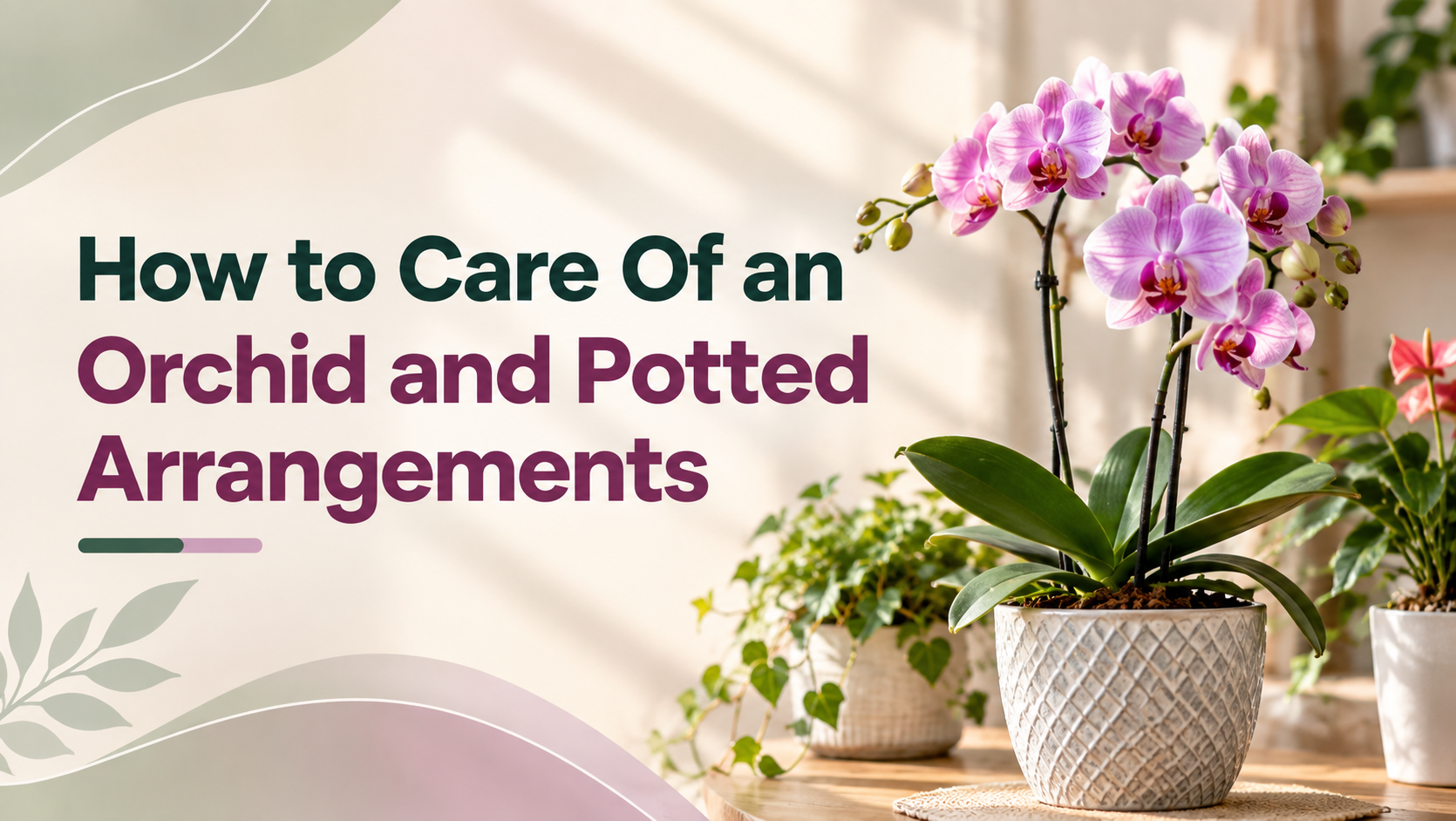
How Do I Take Care of an Orchid Plant? (And Keep a Potted Arrangement Alive Too)
We get the same question almost every week at Apple Blossom: someone picks up a beautiful Phalaenopsis Orchid for a birthday or a sympathy gift, and a few days later they're back asking how do I take care of an orchid plant, because the leaves already look sad. Nine times out of ten, it's not bad luck. It's watering.
Orchids and potted arrangements aren't cared for the same way as a cut bouquet, and they're not cared for the same way as each other either. Here's what actually keeps them going, from the florists who watch these plants leave our Orono shop and, sometimes, come back for advice a month later.
Orchid How to Take Care: The Part Everyone Gets Wrong
Improper watering is the single biggest reason orchids fail. Not too little, usually. Too much.
A healthy orchid, especially the moth orchids (Phalaenopsis) most people receive as gifts, wants water only when the pot feels light and the growing medium has dried out, typically about once a week. Overwatering drowns the roots and can rot the crown of the plant, which is often what kills it outright rather than just weakening it. If you're not sure, wait a day longer than feels right. Orchids recover from being slightly underwatered far more easily than from root rot.
Light matters almost as much. South- or east-facing windows work best. West-facing spots can cook the leaves by late afternoon, and north-facing windows usually don't offer enough brightness for the plant to rebloom. If your orchid has finished flowering and doesn't seem interested in trying again, light is the first thing we'd check, not fertilizer.
A few more details that make a difference:
- Phalaenopsis orchids like it warm and a little humid, somewhere around 18°C to 26°C, which happens to be close to normal room temperature in most homes.
- A modest temperature drop in the evening (a few degrees, nothing dramatic) can help trigger reblooming.
- Feed with a balanced fertilizer during active growth, and ease off in winter while the plant rests. It'll still look green and healthy, it's just not putting energy into new blooms.
- Repot only when the medium breaks down or the plant has clearly outgrown its pot. Fresh, fast-draining bark mix, not garden soil, is what orchid roots need.
If you'd rather skip the guesswork entirely, our heart-shaped mini orchids and full-size potted Phalaenopsis both come from growers we trust to send out healthy, well-established plants, which makes the first few months a lot more forgiving.
Potted Arrangements: A Different Set of Rules
A potted arrangement, whether it's a mixed planter like our Lush Planter Basket or a seasonal gift piece like In The Potting Shed, behaves more like a regular houseplant than an orchid does, and it needs to be treated that way.
The simplest way to know when to water is the finger test: stick your finger into the soil up to the first knuckle. Dry at that depth means it's time to water. Still damp means wait. Smaller pots (around 4 inches) can dry out in a day or two, while larger arrangements might go a week or more between waterings, so there's no single schedule that works for every gift we send out.
Watch for the signs your plant is telling you something. Overwatering tends to show up as yellowing, limp lower leaves, and soil that stays shiny-wet or grows a bit of white mold on top, sometimes with a sour smell. Underwatering looks almost the opposite: crispy brown leaf edges, leaves curling inward, and soil pulling away from the sides of the pot. The good news with underwatering is that most plants bounce back fast once they're properly soaked. Overwatering is the harder one to undo.
A couple of habits make a real difference over time. Empty the saucer under the pot within 10 to 15 minutes of watering, standing water at the roots is a quiet plant-killer. And if you notice your arrangement drying out noticeably faster than it used to, that's usually a sign it's outgrown the pot and needs repotting into something roomier. Our full Plants & Planter Baskets collection has options at a few different sizes if you're shopping for one now, or thinking ahead to when yours needs a bigger home.
Why We Tell Every Customer This
Here's the thing about a gift plant specifically: nobody hands over an orchid or a potted arrangement expecting a care manual, but that first month is what decides whether it becomes a plant someone keeps for years or one that quietly disappears by the next season. We'd rather you know the two or three things that actually matter than watch a beautiful piece struggle because of one wrong habit.
It's also why we'd rather you call or stop into the Orono shop and ask than guess. We've had customers bring photos of a drooping orchid in, and half the time the fix is just "stop watering it for a week and move it away from that west window."
It's also why we build this kind of thing into the bigger events we work on. As a wedding florist, potted pieces come up more than people expect, centerpieces that guests take home, welcome-table arrangements, that sort of thing, and knowing how to keep them alive past the reception is part of what we walk couples through.
Quick Answers
1. How often should I really water an orchid?
About once a week for most Phalaenopsis, but let the pot's weight and the medium's dryness guide you rather than the calendar. A light pot means it's time.
2. Can I use ice cubes to water my orchid?
It's a popular trick, but we don't recommend it as your only method. It can work for controlling volume, but it doesn't replicate the natural watering rhythm orchids are used to, and cold water sitting against tropical roots isn't ideal either. A thorough weekly soak works better long-term.
3. My orchid's flowers all fell off. Is it dead?
No, that's normal. Blooms naturally drop after a few months. The plant itself is still alive and can rebloom with the right light and a bit of patience, sometimes within a few months, sometimes not until the following season.
4. Why is my potted arrangement wilting even though I'm watering it?
That's almost always overwatering, not under. Check the saucer for standing water and check that the pot drains properly. A pot without proper drainage holes will wilt a plant just as fast as neglect will.
If your orchid or potted arrangement from Apple Blossom Flowers isn't looking its best, bring it by our Orono shop or give us a call, we're always happy to take a look and help you figure out what it needs. We handle Oshawa florist delivery, whitby florist delivery, and send flowers bowmanville too, so same-day delivery covers you no matter which of these towns you're in.